
Big vs Small: Who's Actually Winning With AI
By Sharaf Alsharif
Artificial intelligence is the most-funded technology in the world right now, and the assumption baked into most coverage is simple: the biggest companies, with the deepest budgets and the most data, will win it. They spend the most, hire the most, and deploy the most. That story is half right. Large enterprises do lead on raw adoption — but when you separate adoption from return on investment, the advantage flips.
Interplay backs early-stage companies, so we have a direct stake in one question: is scale actually the advantage it appears to be in AI, or do the structural traits of smaller companies — focus, speed, and a willingness to buy rather than build — convert AI into value at a higher rate? The short answer, supported by U.S. government data and top-tier research, is that big companies win the adoption headline while smaller companies win the ROI.
This report draws on the U.S. Census Bureau, the Federal Reserve, the SBA Office of Advocacy, MIT Project NANDA, McKinsey, Salesforce, and Goldman Sachs’ 10,000 Small Businesses program, all published between 2024 and 2026. Every figure is cited, and the handful we could not confirm in a primary document are flagged directly.
Methodology
We split our research into two questions:
- Rate of AI adoption by company size in the U.S. — the “who is using it” question.
- Rate of AI success and return on investment by company size — the “who is winning with it” question, including why enterprise pilots stall, buy-vs-build outcomes, and where smaller firms actually capture value.
Data categorization. Companies segmented by size: micro (<5 employees), small (5–99 employees), mid-size (100–249), and large enterprise (250+ employees or >$5B revenue). Outcomes classified as adoption (using AI at all), value capture (measurable P&L or revenue impact), sentiment (whether leaders believe AI helps their business), and deployment approach (buy-from-vendor vs build-internally).
Part I: Adoption — Big companies lead, but the gap is closing
On raw adoption, large firms are still ahead
The cleanest size-cut comes from the U.S. Census Bureau’s Business Trends and Outlook Survey, a large, nationally representative biweekly survey of U.S. businesses. As of the collection period ending May 3, 2026, adoption rises with size: 37% of firms with 250 or more employees reported using AI, 32% of firms with 100–249 employees, and under 20% of firms with four or fewer employees. Census’s own headline was blunt: large firms with at least 20 employees are the biggest AI users. We are not going to pretend otherwise — on the raw “do you use AI” question, scale wins.

But small firms punch above their weight — and are closing the gap fast
Three facts complicate the “big wins” story. First, the Federal Reserve found that “adoption among the smallest firms is stronger than would be expected based on size alone,” and that LLM-specific adoption is “comparable among all but the largest cohort.” Second, the SBA reports small-business AI use climbing from 6.3% to 8.8% in six months while large-firm use held roughly flat — putting small firms only about a year behind. Third, small firms already lead in specific use cases such as automated marketing. The direction of travel favors the little guys.
The pivot. Big companies win the adoption race today. The rest of this report is about the race that actually matters: turning adoption into return. There, the picture reverses.
Part II: Success & ROI — Small companies win the return
Enterprise AI mostly doesn’t pay off yet
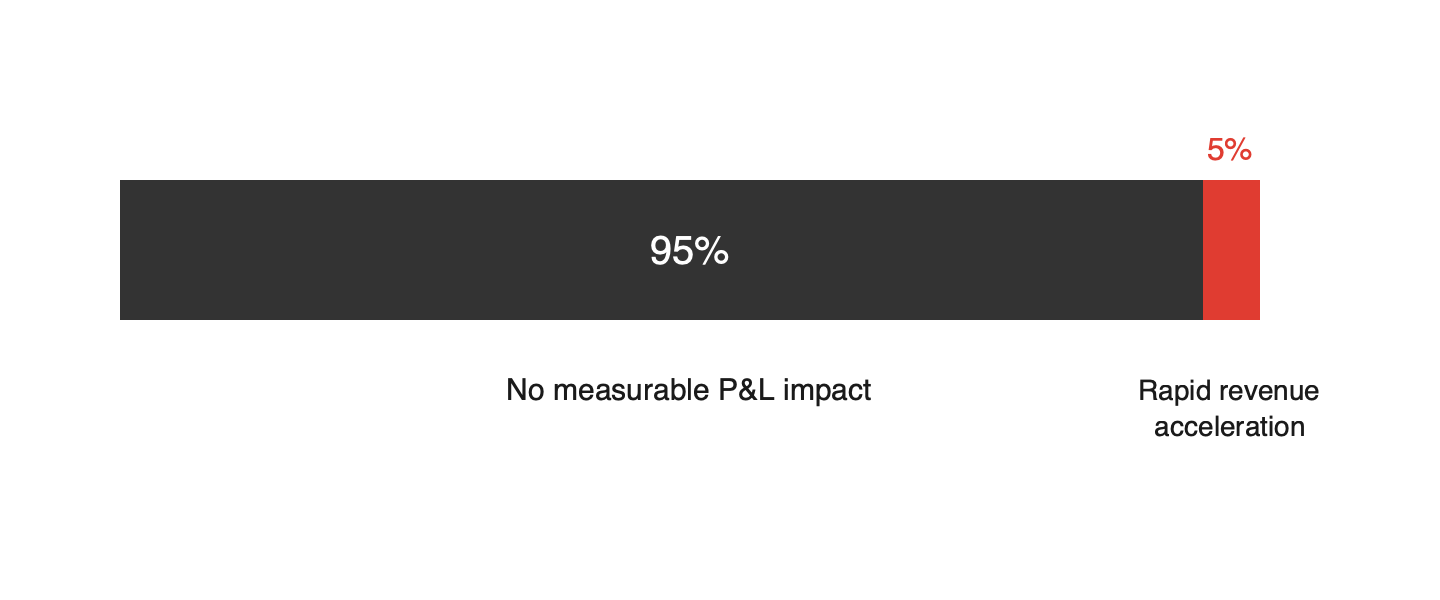
MIT Project NANDA’s “The GenAI Divide” study — built on 150 leader interviews, 350 employee surveys, and analysis of 300 public AI deployments — found that roughly 95% of enterprise generative-AI pilots deliver no measurable profit-and-loss impact, after an estimated $30–40 billion of enterprise spend. Only about 5% achieve rapid revenue acceleration. McKinsey corroborates the ceiling from a different angle: 88% of organizations use AI in at least one function, yet only a single-digit minority (~6%) qualify as high performers capturing 5%+ EBIT impact, and only a small minority describe their AI as fully scaled.
Why enterprise pilots stall — it’s the organization, not the model
MIT is emphatic that the failure is not about model quality. The core problem is a learning gap: as lead author Aditya Challapally explained to Fortune, generic tools like ChatGPT excel for individuals because of their flexibility but stall in enterprise use because they don’t learn from or adapt to workflows. Four failure patterns recur across the research:
- The learning gap. Pilots can’t retain feedback, adapt to context, or improve over time — so they never graduate from demo to production.
- Budget misallocation. More than half of GenAI budgets go to sales and marketing tools, yet MIT found the biggest ROI in back-office automation — cutting BPO, agency, and ops costs.
- Shadow AI. In over 90% of firms, employees quietly use personal AI tools even when the official enterprise pilot fails — value is happening off the books, uncounted and ungoverned.
- The verification tax. When enterprise AI is confidently wrong, employees spend more time double-checking outputs than they save, erasing the productivity gain.
Layer on data silos, procurement drag, compliance review, and org politics, and the large-company structure that looks like an advantage becomes the thing that smothers the pilot.
Case study — McDonald’s × IBM drive-thru. In October 2021, McDonald’s and IBM announced a high-profile partnership to bring AI-powered voice ordering — branded the Automated Order Taker, or AOT — to McDonald’s drive-thru lanes. It was exactly the kind of ambitious, bespoke enterprise build that MIT’s NANDA research flags as the failure mode. The system was piloted at more than 100 U.S. locations. By mid-2024, a wave of viral videos had captured the AOT misinterpreting orders — most famously ringing up 260 McNuggets, and adding bacon to a customer’s ice cream. In a June 2024 memo from Chief Restaurant Officer Mason Smoot, obtained by CNBC and Restaurant Business, McDonald’s told franchisees it would remove IBM’s Automated Order Taker from all restaurants by July 26, 2024. The company said it would continue to “explore voice ordering more broadly.” IBM said its underlying technology was in discussions and pilots with several other Quick-Serve Restaurant clients. The lesson matches the MIT finding almost exactly: an enterprise with abundant capital, a marquee vendor partnership, and a well-defined use case still could not get a bespoke AI deployment to the point of measurable, reliable P&L impact.
The winners buy; the losers build — and size decides which path you take
The same MIT research found AI initiatives bought from specialized vendors or built through partnerships succeed about 67% of the time, while internal builds succeed roughly half as often (~one-third reach production). The tragedy is structural: large, regulated enterprises — especially in financial services — disproportionately try to build their own proprietary systems for reasons of IP control, data sovereignty, and “not invented here.” As MIT’s author observed, “almost everywhere we went, enterprises were trying to build their own tool” — and “the data showed purchased solutions delivered more reliable results.” Smaller companies, lacking the budget and headcount to build, buy and partner by necessity — landing them on the winning side of the ratio by default.

Where small companies actually find ROI
Small firms aren’t just optimistic — they report concrete returns, concentrated in a few high-leverage functions. A Salesforce survey of 3,350 SMB leaders found 91% of small and medium businesses using AI say it boosts revenue; 87% say it helps them scale operations and 86% see improved margins. Goldman Sachs’ 10,000 Small Businesses survey (1,256 U.S. owners, early 2026) found 76% of small businesses now use AI, 93% of those report a positive impact, and 84% cite increased efficiency and productivity as the primary benefit. The recurring, ROI-positive use cases:
- Marketing & content. Campaign optimization, content generation, automated product recommendations — the area where SBA says small firms actually lead large ones.
- Customer service. Automated chatbots and natural-language support that let a tiny team cover enterprise-scale service hours.
- Sales automation. Drafting personalized prospecting emails and surfacing “next best actions” for lean sales teams.
- Back-office & admin. The exact category MIT found delivers the biggest enterprise ROI — and small firms hit it first because they have no BPO layer to protect.
Two honesty notes: the Salesforce and Goldman figures are optimism/impact surveys (self-reported), and only 14% of small firms say AI is “fully embedded” in core operations — adoption still outruns integration. But the direction is unambiguous: small firms spend little and report high, specific value.
Case study — Connie’s Chicken and Waffles. Khari Parker, co-founder of the Baltimore-based restaurant Connie’s Chicken and Waffles, is one of the small-business owners Goldman Sachs’ 10,000 Small Businesses program has held up as a Main Street AI success story. In interviews Parker has said he uses off-the-shelf tools like ChatGPT and Claude for the kinds of jobs a small restaurant never has time for: designing menus, drafting flyers, recruiting, staff training, and forecasting supply. He describes AI as “a tiebreaker” that lets him make faster decisions without a bigger back office. It is exactly the pattern this piece has been arguing for at scale: small firms adopt narrow, task-shaped AI, deploy it against a real pain point, and pocket productivity gains without the enterprise overhead that usually swallows the ROI. As Parker put it in Goldman’s own release, “AI is already helping small businesses compete, save time, and better serve customers.” Goldman’s 2026 survey found 76% of small-business owners now use AI, and 93% of those report positive impact — Parker is one of the 93%.
Part III: The Quadrant
High spend, low payoff vs. low spend, high payoff
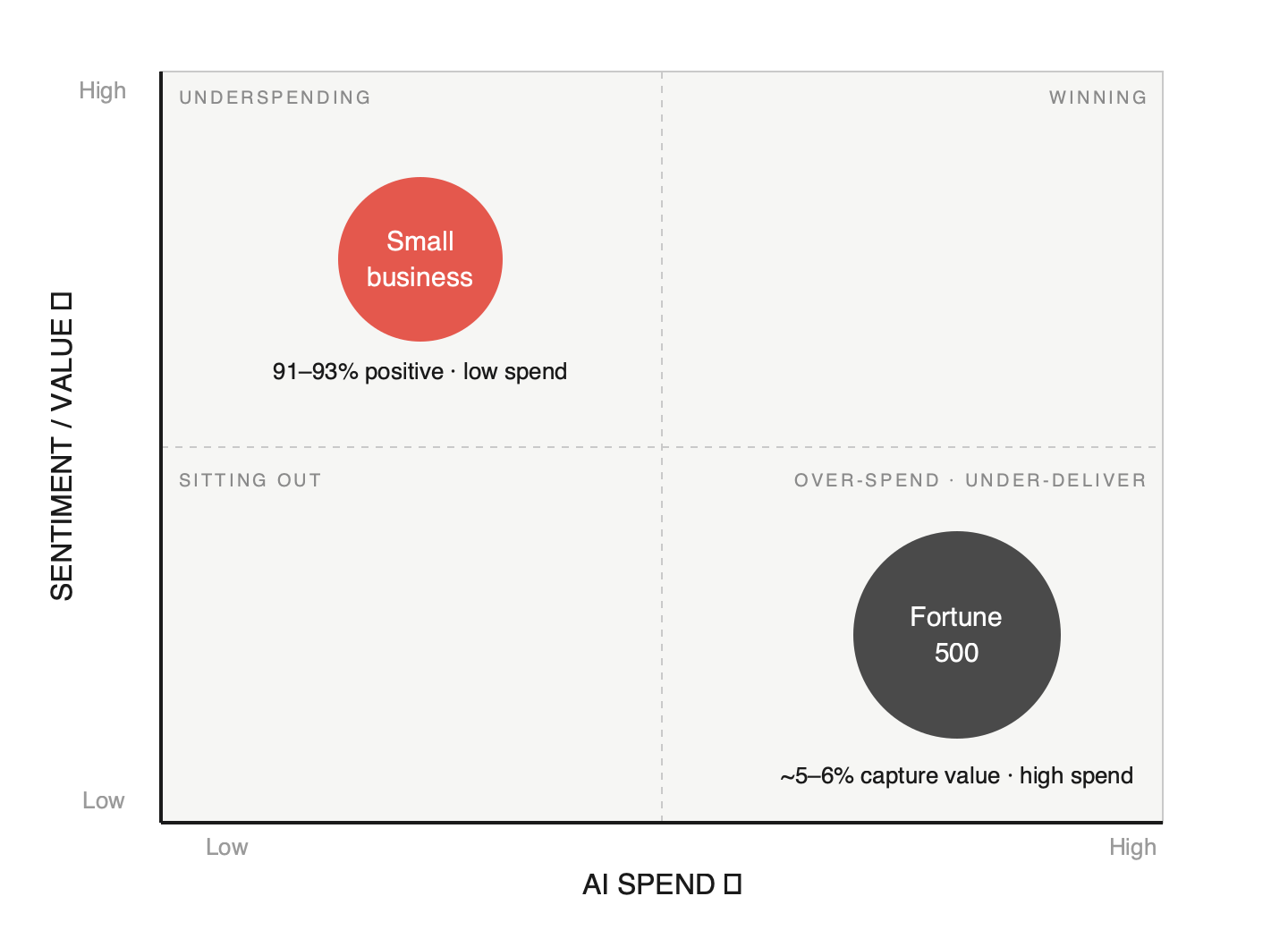
Plot the two cohorts on spend against sentiment and the divide is stark. Fortune 500 enterprises sit high on spend — tens of billions collectively — but their measured payoff is muted, with only ~5–6% capturing real value. Small businesses sit low on spend but high on positive sentiment, with 91–93% reporting AI helps their business. One important caveat: this isn’t perfectly apples-to-apples — SMB sentiment comes from optimism surveys while enterprise “sentiment” is inferred from hard P&L studies, and enterprises show wide internal variance (a bullish elite alongside a stalled majority). But as a strategic map, the pattern holds.
What leaders are saying
“We are investing in AI — hundreds of thousands of dollars a year — and implementing it throughout the organization. We see pockets of efficiency. But we have not seen the returns on that investment yet.”
Gil Mandelzis, CEO, Capitolis · Fortune op-ed, May 27, 2026
“Almost everywhere we went, enterprises were trying to build their own tool” — but, Fortune reported, the data showed purchased solutions delivered more reliable results.
Aditya Challapally, lead author, MIT Project NANDA “GenAI Divide” · via Fortune, August 18, 2025
“The SaaSpocalypse is over. It’s finished, no more.” … “Around 50% of our new revenue is AI revenue, agentic revenue.” “AI is an enormous tailwind for software companies.”
Orlando Bravo, Founder & Managing Partner, Thoma Bravo · CNBC, June 9, 2026
Valuations in AI are “at a bubble.” “That company is going to have to produce a billion dollars in free cash flow to double an investor’s money, ultimately… that’s a tall order, managerially.”
Orlando Bravo, Thoma Bravo · CNBC, October 7, 2025 · on AI valuation discipline
“We’ve obviously been spending a lot of time the last week looking at the impact of DeepSeek… The real question is what is demand going forward?”
Jonathan Gray, President & COO, Blackstone · Blackstone Q4 2024 earnings call, January 30, 2025 (via Business Insider)
“If you think about Goldman Sachs and the value it brings to its clients, its value is deployed really among three different things: people, capital, technology.” — predicting AI may increase the firm’s headcount over the next decade.
David Solomon, Chairman & CEO, Goldman Sachs · via Business Insider, early October 2025
“AI is already helping small businesses compete, save time, and better serve customers — but many of us are still figuring out how to use it effectively. With the right guidance and training, AI can be transformational for Main Street.”
Khari Parker, co-founder, Connie’s Chicken and Waffles · via Goldman Sachs 10,000 Small Businesses, 2026
The takeaway. This isn’t “small good, big bad.” It’s that AI rewards focus, speed, and buy-vs-build discipline — three things smaller companies have by default and larger companies have to fight for. Big companies win the adoption headline. Smaller companies win the return.
Sources
- U.S. Census Bureau — “Use of AI by U.S. Businesses,” Business Trends and Outlook Survey (May 2026, collection period ending May 3, 2026).
- Federal Reserve (FEDS Notes) — “Monitoring AI Adoption in the US Economy” (Apr 3, 2026).
- SBA Office of Advocacy — “AI in Business: Small Firms Closing In” (Sept 24, 2025).
- MIT Project NANDA — “The GenAI Divide: State of AI in Business 2025.” Via Fortune (Aug 18, 2025) and Forbes (Aug 26, 2025).
- McKinsey — “The State of AI 2025” (Nov 5, 2025).
- Salesforce — SMB Trends Report; 3,350 SMB leaders (survey fielded Aug–Sep 2024; published 2024).
- Goldman Sachs — 10,000 Small Businesses Voices, AI survey (2026).
- Orlando Bravo (Thoma Bravo) — CNBC (Oct 7, 2025) and CNBC (Jun 9, 2026).
- Jonathan Gray (Blackstone) — Blackstone Q4 2024 earnings call (Jan 30, 2025), reported by Business Insider (Jan 31, 2025).
- David Solomon (Goldman Sachs) — Business Insider (October 2025).
- Gil Mandelzis (Capitolis) — Fortune op-ed (May 27, 2026).
By Sharaf Alsharif, Interplay · Data verified July 2026. SMB sentiment figures (Salesforce, Goldman) are self-reported optimism surveys; enterprise value figures (MIT, McKinsey) are measured P&L outcomes — the two are directionally comparable, not identical instruments. Quadrant bubble placement is illustrative of the documented direction. Figures move quarterly — re-verify before quoting externally.